Passage Planner
Maritime Automation · VBA · Excel
Overview
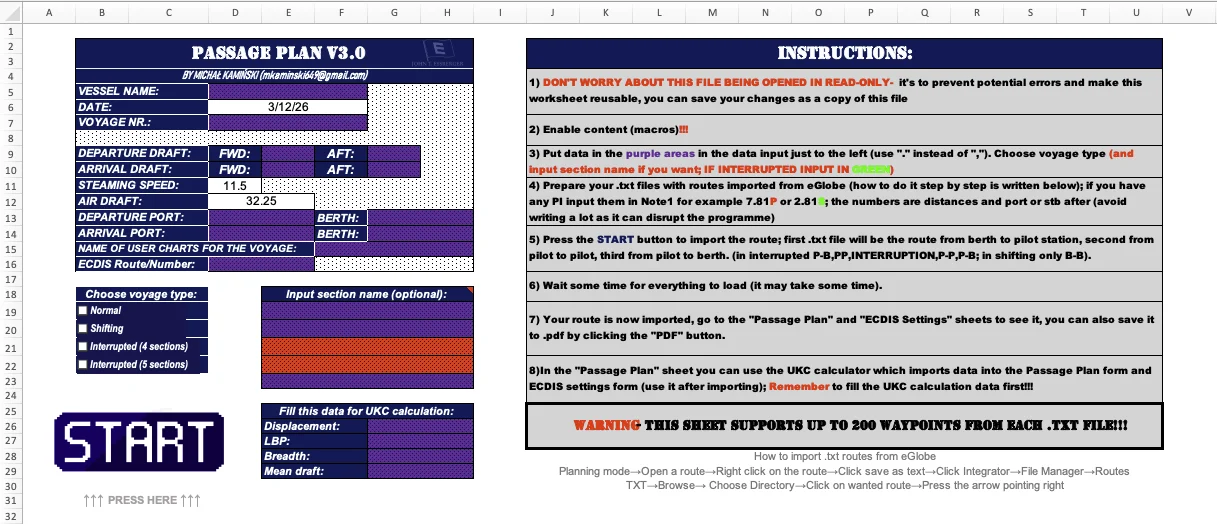
The first thing I ever built, and still the one I am most proud of. There is a moment in Meet the Robinsons where Lewis says his greatest invention was his very first one. I think about that sometimes when I think about this. This was a macro-powered Excel workbook written mid-voyage on a chemical tanker, somewhere in the Baltic, with ship Wi-Fi that was more of a rumour than a service. It cut a regulatory process officers spent 3 to 4 hours on before every departure down to under five minutes. Version 3.0 is still running on a vessel somewhere today.
The challenge
Every vessel is legally required to complete a Passage Plan before sailing. It is a detailed regulatory document covering every waypoint, course and speed changes, under-keel clearance calculations, ECDIS safety contour settings, and draft evaluations. The company had a template for this. It was locked, inflexible, and required officers to manually transcribe every single waypoint from the onboard navigation system by hand, then work out all the safety margins for each one. Routes regularly ran to 200 or more waypoints across three segments. Officers were spending 3 to 4 hours per voyage on data entry alone, every single time.
The approach
- 01 Studied the locked regulatory template and Bridge Procedures Manual requirements while standing regular watch rotations. No dedicated engineering time, just whatever gaps existed between shifts.
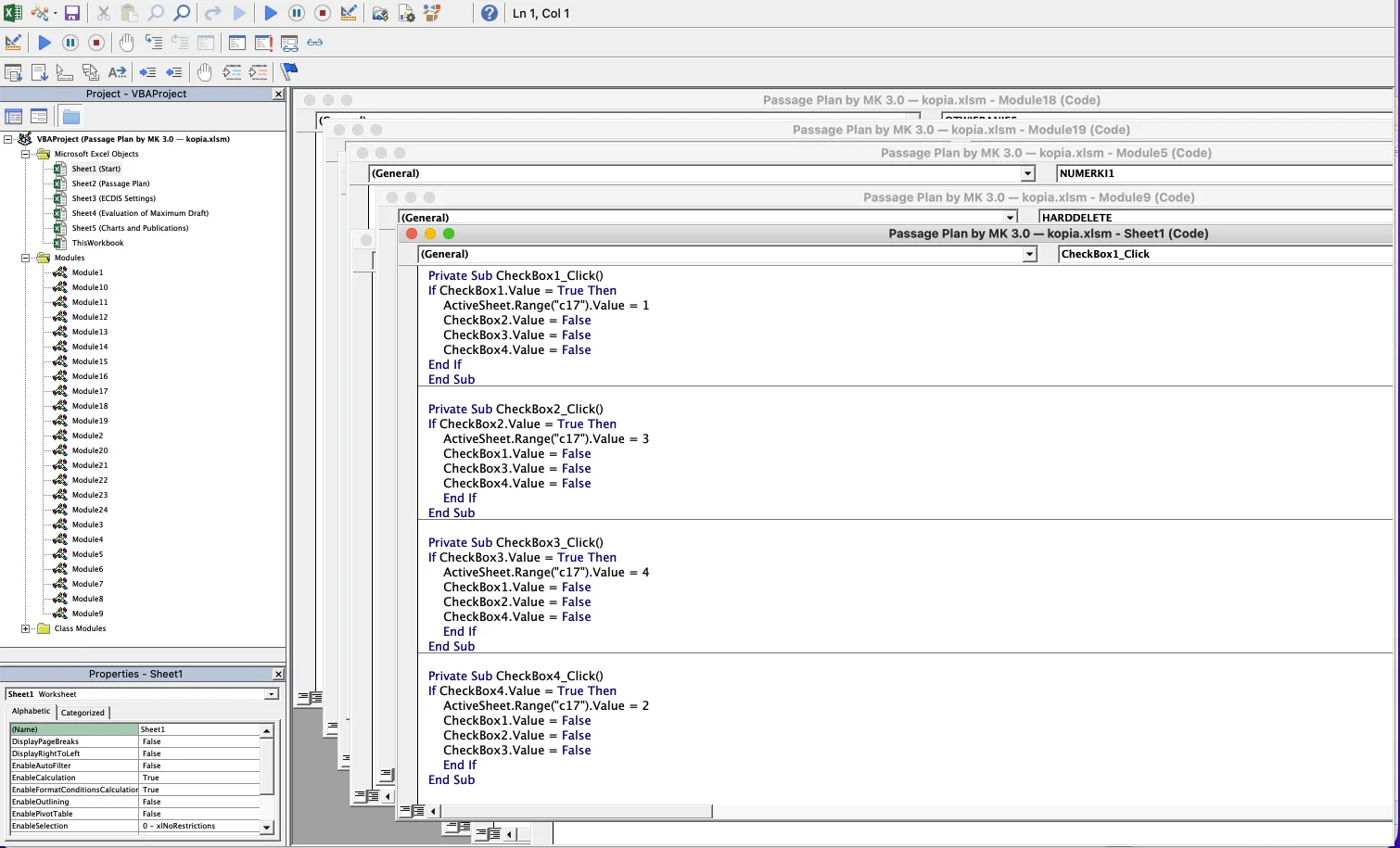
- 02 Wrote VBA macros to parse .txt route exports directly from eGlobe (the onboard navigation system) and auto-populate the full Passage Plan form across all three voyage segments, handling up to 200 waypoints each.
- 03 Built a UKC (under-keel clearance) calculator into the Start screen: enter vessel particulars and departure data once, and squat, tidal allowances, water density correction, and ECDIS safety contour derivations are all calculated automatically per waypoint.
- 04 Shipped almost entirely offline, mostly from documentation saved before departure, on barely-there satellite internet, with no Stack Overflow and no one to ask.
Outcome
What took officers 3 to 4 hours now takes under five minutes. The tool was picked up across the fleet. The year after, I was invited to Hamburg to develop a fleet-wide version for MRV and DCS reporting. Seafarers do not usually get invited to do things like that. That Hamburg project turned out to be the direct predecessor to everything I later did at DNV, where I spent two years verifying the exact same MRV and DCS reports I had just helped build the tooling for. The road from a ship in the Baltic to a regulatory software career could not have been more direct. The original v3.0 is still in use today. That fact never gets old.
Working on something in the maritime software or applied AI space? Let's talk →
Next project